Young People Urged to Receive Lifesaving MenB Jab

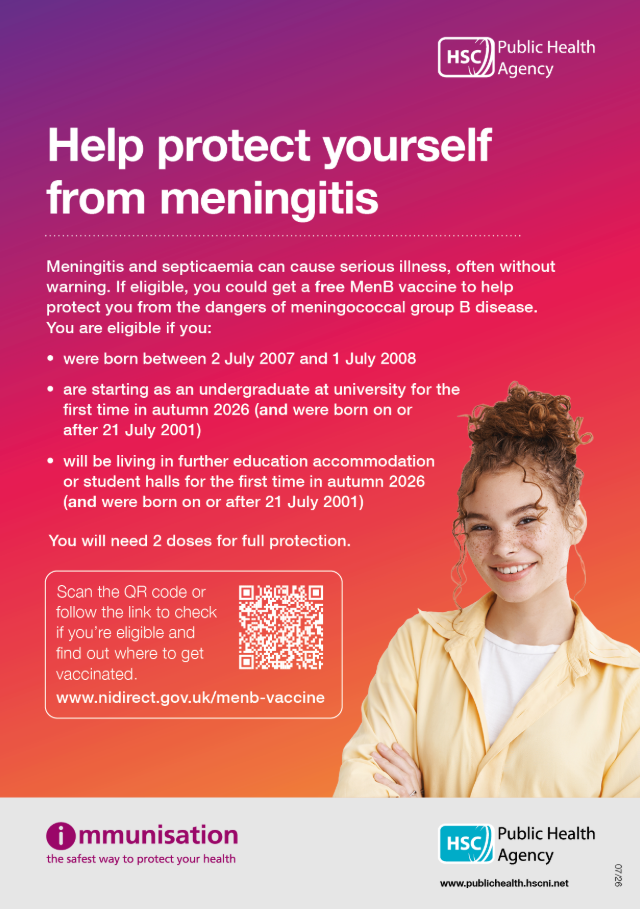
HSC Public Health Agency poster with a pink-to-orange gradient background promoting meningitis vaccination. Large heading reads, “Help protect yourself from meningitis.” The poster explains that meningitis and septicaemia can cause serious illness and that eligible people can receive a free MenB vaccine to protect against meningococcal group B disease. Eligibility includes people born between 2 July 2007 and 1 July 2008, first-time undergraduate university students starting in autumn 2026 who were born on or after 21 July 2001, and students moving into further education accommodation or halls for the first time in autumn 2026 who were born on or after 21 July 2001. The poster notes that two doses are needed for full protection. A QR code and web address (www.nidirect.gov.uk/menb-vaccine) are provided for checking eligibility and finding vaccination locations. An image of a person in a light-coloured shirt appears on the lower right. Logos for the HSC Public Health Agency and Immunisation programme are displayed at the top and bottom of the poster.

HSC Public Health Agency poster with a pink-to-orange gradient background promoting meningitis vaccination. Large heading reads, “Help protect yourself from meningitis.” The poster explains that meningitis and septicaemia can cause serious illness and that eligible people can receive a free MenB vaccine to protect against meningococcal group B disease. Eligibility includes people born between 2 July 2007 and 1 July 2008, first-time undergraduate university students starting in autumn 2026 who were born on or after 21 July 2001, and students moving into further education accommodation or halls for the first time in autumn 2026 who were born on or after 21 July 2001. The poster notes that two doses are needed for full protection. A QR code and web address (www.nidirect.gov.uk/menb-vaccine) are provided for checking eligibility and finding vaccination locations. An image of a person in a light-coloured shirt appears on the lower right. Logos for the HSC Public Health Agency and Immunisation programme are displayed at the top and bottom of the poster.

In June, Health Minister Mike Nesbitt announced that a one-off Meningococcal B (MenB) vaccination programme for adolescents would be rolled out in Northern Ireland, aimed at helping to protect those who are considered to be at the highest risk of MenB.

PHA has released details of the programme and are urging thousands of young people heading to university and further education colleges this autumn to book their potentially lifesaving free MenB vaccine.

Vaccinations are being offered through GP practices and participating community pharmacies across Northern Ireland. Two doses of the MenB vaccine given at least four weeks apart are needed for the maximum possible protection.

Those who are eligible are:

  • all people born between 2 July 2007 and 1 July 2008
  • people born on or after 21 July 2001 and starting university for the first time this autumn (including international students)
  • people born on or after 21 July 2001 who are starting in some residential further education colleges for the first time this autumn (including international students)

Rachel Spiers, Senior Commissioning Lead for Immunisations at the PHA, said: “Meningococcal B infections can cause serious, life-threatening problems including inflammation of the lining of the brain – meningitis – and septicaemia, which is blood poisoning. This can lead to life-changing disabilities such as amputations, hearing loss and brain damage, and in some cases can prove fatal.

“The bacteria that cause MenB disease can be spread through close contact with an infected person. This can be through kissing, sharing drinks or vapes, or prolonged close contact with the person for long periods of time, such as living in the same home.

“Students in their first year of university or college have a risk that is about seven times higher than that of young people of a similar age who do not go to university. Sadly, we have seen the tragic consequences of MenB earlier this year with the outbreak in Kent so if you’re eligible, don’t leave it to chance – get vaccinated.”

Other important information
It is also important that students, staff and families remain vigilant for the signs and symptoms of meningitis and act fast if they suspect they may have it.

Symptoms of meningitis develop suddenly and can include:

  • a high temperature (fever) over 37.5C (99.5F);
  • being sick;
  • a headache;
  • a blotchy rash that doesn’t fade when a glass is rolled over it (this won’t always develop);
  • a stiff neck;
  • a dislike of bright lights;
  • drowsiness or unresponsiveness;
  • seizures (fits).

These symptoms can appear in any order and some may not appear. Call 999 immediately or go to your nearest A&E if you think you or a friend/family member could have meningitis, septicaemia or sepsis. Trust your instincts and do not wait for all symptoms or for a rash to develop. People with meningitis, septicaemia or sepsis can become seriously unwell very quickly.

Download Poster: https://www.publichealth.hscni.net/publications/help-protect-yourself-meningitis-poster

You can find out more at www.nidirect.gov.uk/MenB

e-Bug Resource

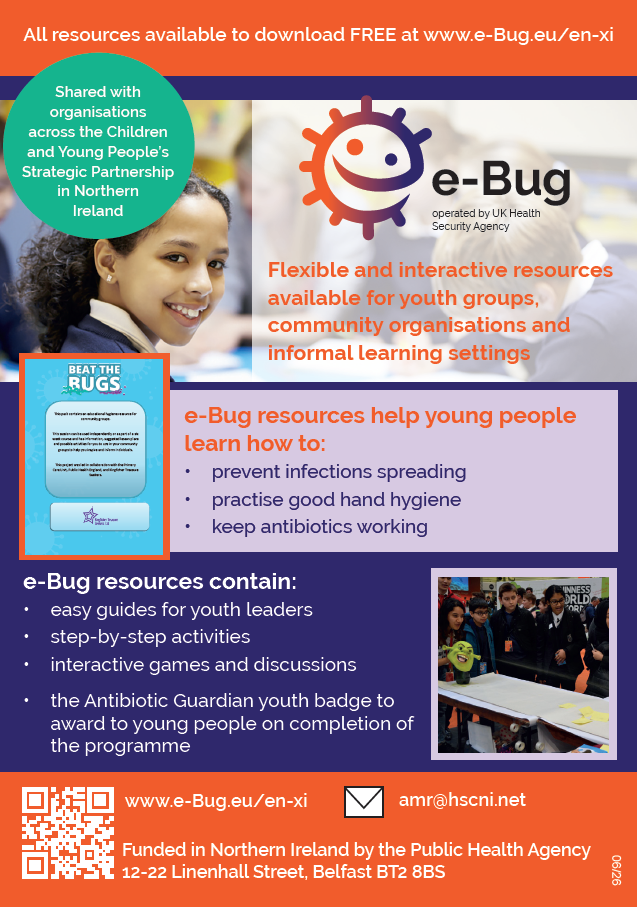
Promotional leaflet for e-Bug, a free health education programme operated by the UK Health Security Agency. The leaflet promotes flexible, interactive resources for youth groups, community organisations and informal learning settings across Northern Ireland. It includes the e-Bug logo, photos of young people taking part in activities, and a "Beat the Bugs" resource cover. Key messages highlight learning to prevent infections spreading, practise good hand hygiene and keep antibiotics working. The leaflet lists resources such as guides for youth leaders, step-by-step activities, interactive games and discussions, and the Antibiotic Guardian youth badge. Contact details, a website link (www.e-Bug.eu/en-xi), email address (amr@hscni.net) and a QR code are provided.

Promotional leaflet for e-Bug, a free health education programme operated by the UK Health Security Agency. The leaflet promotes flexible, interactive resources for youth groups, community organisations and informal learning settings across Northern Ireland. It includes the e-Bug logo, photos of young people taking part in activities, and a “Beat the Bugs” resource cover. Key messages highlight learning to prevent infections spreading, practise good hand hygiene and keep antibiotics working. The leaflet lists resources such as guides for youth leaders, step-by-step activities, interactive games and discussions, and the Antibiotic Guardian youth badge. Contact details, a website link (www.e-Bug.eu/en-xi), email address (amr@hscni.net) and a QR code are provided.

The e-Bug Programme is an international partnership hosted by UKHSA. It aims to help countries respond to their National Action Plans to contain and control antimicrobial resistance, by promoting context specific public education on preventing infections and responding to antimicrobial resistance 

The e-Bug programme supports UK Government efforts to respond to antimicrobial resistance by promoting public education on: 

  • Preventing infection, including promoting good hygiene practices in homes, schools and communities
  • Understanding the symptoms and signs of infection, and knowing when to self-care and when to seek professional advice
  • Knowing the risks and benefits of antimicrobials, and only taking them as and when directed by a healthcare professional

This is done by providing wrap around messaging to children and young people through their trusted information sources, including their schools, their parents and caregivers, and their community leaders. 

Download Flyer

e-Bug website – https://www.e-bug.eu/en-xi

May is Women’s Health Month

Eating well is essential for women at evey stage of life.

To find out more about nutrition and women’s health, scan the QR code below or follow this link: https://www.youtube.com/playlist?list=PLVutsY_gd5AZJ1ItjHH843RiTnQw_kabg

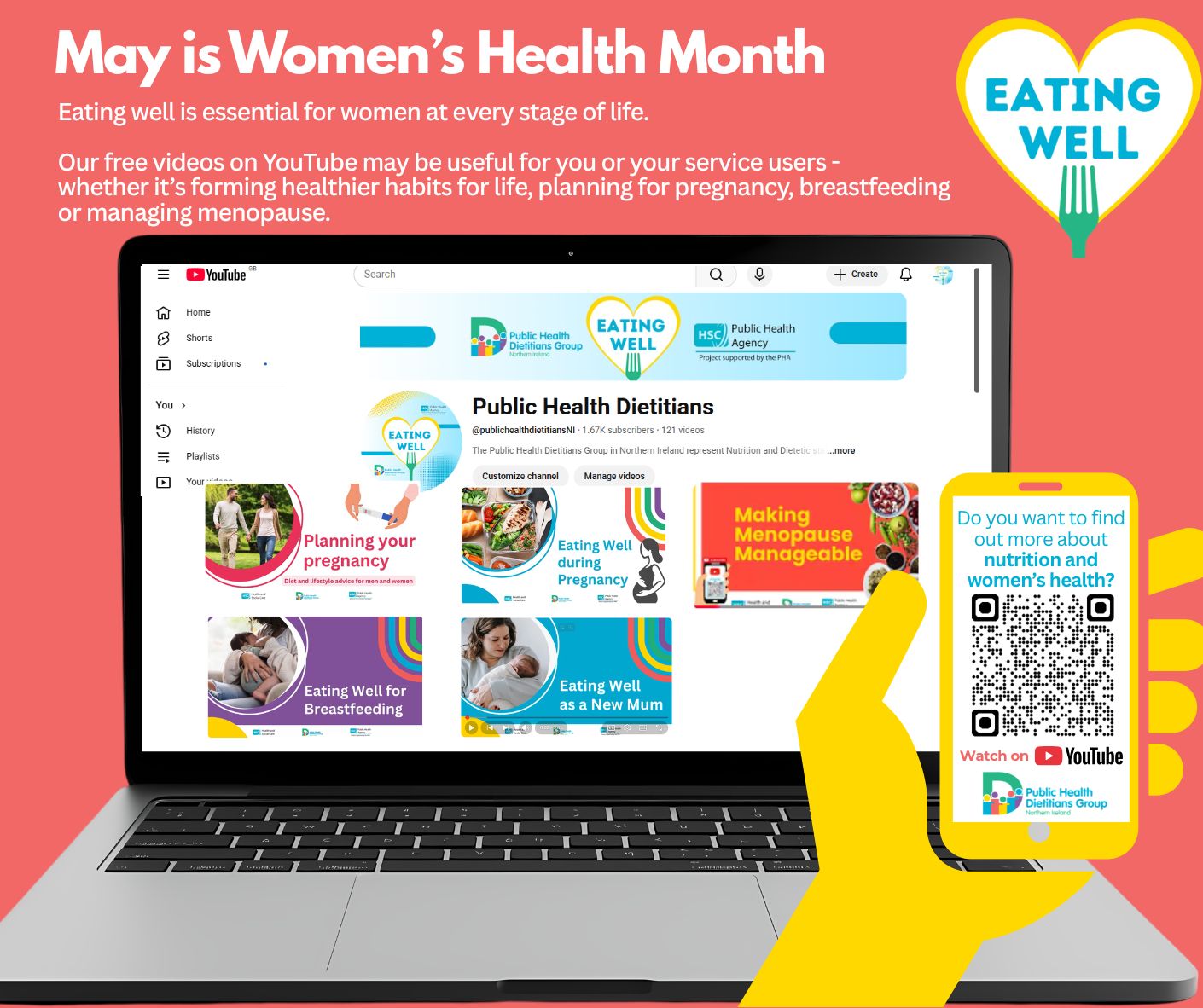
Promotional graphic for Women’s Health Month in May. The text reads “May is Women’s Health Month” and highlights the importance of eating well at every stage of life. A laptop displays the Public Health Dietitians YouTube channel with videos on planning pregnancy, healthy eating during pregnancy, breastfeeding, being a new parent, and managing menopause. To the side, a hand holds a mobile phone showing a QR code inviting viewers to learn more about nutrition and women’s health on YouTube, alongside an “Eating Well” heart-shaped logo

A Healthier You in 2026

The new year is synonymous with resolutions. For many, this means diving headfirst into weight loss plans and fitness challenges. While the motivation is admirable, it can also feel overwhelming. Where do you start? What should you do differently this time?

Enter social media—an endless stream of advice, trends, and “quick fixes.” Unfortunately, much of it is confusing, conflicting, and sometimes downright misleading. In fact, only around 2% of nutrition information on TikTok is considered accurate. That begs the question: how do you know if the advice you’re following is actually helping—or quietly harming—your health?

This is where expert guidance matters.

Public Health Dietitians are trained professionals who cut through the noise and focus on what truly works – for your body, your lifestyle, and your long-term health. There are no extreme rules, no food guilt, and no unrealistic promises. Just evidence-based advice designed to help you make small, sustainable changes that add up over time.

Through a series of short, practical videos, you can learn how to support your weight management goals without compromising your health or the nutritional quality of your diet. No frenzy. No pressure. Just steady, supportive steps forward.

Do Not focus on what goes ‘wrong’ or what you didn’t achieve, take a moment to acknowledge what you did. Every positive choice counts—whether it’s walking a little more, drinking more water, cooking one extra meal at home, or simply thinking differently about your health. Even the smallest step forward is still progress. And progress, no matter how quiet, is powerful. 

This year, let your health journey be kinder, smarter, and more sustainable. Celebrate your wins, trust credible experts, and remember—you don’t need to overhaul your life overnight. You just need to start.  

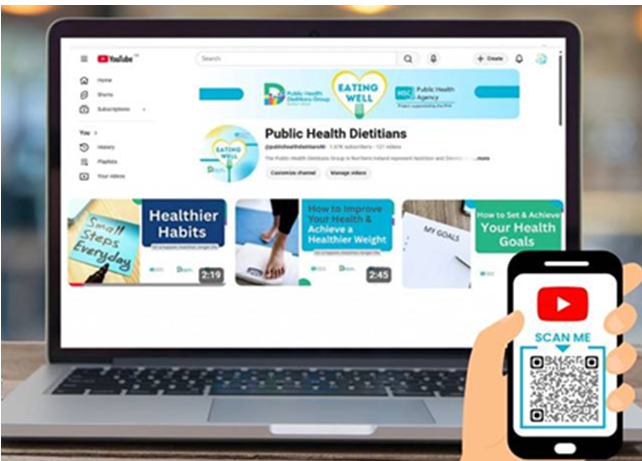
A laptop displaying a YouTube channel page titled “Public Health Dietitians” with a banner that includes the logo “Eating Well” and the Public Health Agency branding. The channel features videos such as “Healthier Habits,” “How to Improve Your Health & Achieve a Healthier Weight,” and “How to Set & Achieve Your Health Goals.” In the foreground, a hand is holding a smartphone showing a QR code with the text “SCAN ME” and a red YouTube play button above it

And that start can be today…. check out the PHDG YouTube channel today for a ……  

A Healthier You in 2026

New short videos on Public Health Dietitians YouTube channel:

  • Healthier habits for a happier, healthier, longer life
  • How to improve your health and achieve a healthier weight
  • How to set and achieve your health goals

Find the videos here: https://youtu.be/0uB5bvuaykA?si=kQuBoTfybWjMHmRi or scan the QR code

Fuel the Fun with Smart Snacks

A collage of three video thumbnails from the Public Health Dietitians series on children’s snacks. The first thumbnail shows three children sitting at a table with snacks, titled ‘How to Build a Healthy Snack for Children’. The second shows a child holding an apple, titled ‘When to Give Children Snacks’. The third is a close-up of a child’s face, titled ‘Do Children Need Snacks?’.

This new series of short videos from Public Health Dietitians are designed to help parents and caregivers make healthy snack choices for their children.

This video series is packed with easy, practical tips you can use straight away – perfect for busy parents, carers, and anyone keeping hungry kids happy.

From what to keep stocked in the fridge or cupboard, to quick, budget-friendly snack ideas that kids will actually enjoy, these videos have you covered. You’ll also find handy advice on timing, portion sizes, and planning ahead—making it easier to keep little tummies full and fuelled with the nutrition they need.

✨ The first three videos are ready to watch now on the Public Health Dietitians YouTube channel:
www.youtube.com/playlist?list=PLVutsY_gd5AYnalVYTCXNoKDh9anjQ9P2

For even more tips, check out the full article here:
https://www.publichealth.hscni.net/news/snack-smart-summer-new-video-series-helps-parents-healthy-snack-tips-kids