
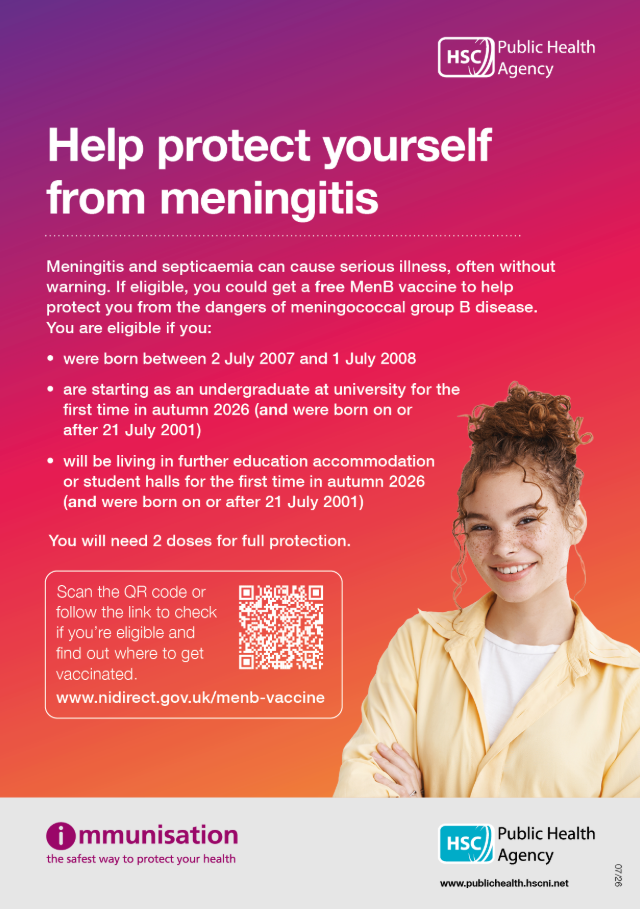
HSC Public Health Agency poster with a pink-to-orange gradient background promoting meningitis vaccination. Large heading reads, “Help protect yourself from meningitis.” The poster explains that meningitis and septicaemia can cause serious illness and that eligible people can receive a free MenB vaccine to protect against meningococcal group B disease. Eligibility includes people born between 2 July 2007 and 1 July 2008, first-time undergraduate university students starting in autumn 2026 who were born on or after 21 July 2001, and students moving into further education accommodation or halls for the first time in autumn 2026 who were born on or after 21 July 2001. The poster notes that two doses are needed for full protection. A QR code and web address (www.nidirect.gov.uk/menb-vaccine) are provided for checking eligibility and finding vaccination locations. An image of a person in a light-coloured shirt appears on the lower right. Logos for the HSC Public Health Agency and Immunisation programme are displayed at the top and bottom of the poster.
In June, Health Minister Mike Nesbitt announced that a one-off Meningococcal B (MenB) vaccination programme for adolescents would be rolled out in Northern Ireland, aimed at helping to protect those who are considered to be at the highest risk of MenB.
PHA has released details of the programme and are urging thousands of young people heading to university and further education colleges this autumn to book their potentially lifesaving free MenB vaccine.
Vaccinations are being offered through GP practices and participating community pharmacies across Northern Ireland. Two doses of the MenB vaccine given at least four weeks apart are needed for the maximum possible protection.
Those who are eligible are:
- all people born between 2 July 2007 and 1 July 2008
- people born on or after 21 July 2001 and starting university for the first time this autumn (including international students)
- people born on or after 21 July 2001 who are starting in some residential further education colleges for the first time this autumn (including international students)
Rachel Spiers, Senior Commissioning Lead for Immunisations at the PHA, said: “Meningococcal B infections can cause serious, life-threatening problems including inflammation of the lining of the brain – meningitis – and septicaemia, which is blood poisoning. This can lead to life-changing disabilities such as amputations, hearing loss and brain damage, and in some cases can prove fatal.
“The bacteria that cause MenB disease can be spread through close contact with an infected person. This can be through kissing, sharing drinks or vapes, or prolonged close contact with the person for long periods of time, such as living in the same home.
“Students in their first year of university or college have a risk that is about seven times higher than that of young people of a similar age who do not go to university. Sadly, we have seen the tragic consequences of MenB earlier this year with the outbreak in Kent so if you’re eligible, don’t leave it to chance – get vaccinated.”
Other important information
It is also important that students, staff and families remain vigilant for the signs and symptoms of meningitis and act fast if they suspect they may have it.
Symptoms of meningitis develop suddenly and can include:
- a high temperature (fever) over 37.5C (99.5F);
- being sick;
- a headache;
- a blotchy rash that doesn’t fade when a glass is rolled over it (this won’t always develop);
- a stiff neck;
- a dislike of bright lights;
- drowsiness or unresponsiveness;
- seizures (fits).
These symptoms can appear in any order and some may not appear. Call 999 immediately or go to your nearest A&E if you think you or a friend/family member could have meningitis, septicaemia or sepsis. Trust your instincts and do not wait for all symptoms or for a rash to develop. People with meningitis, septicaemia or sepsis can become seriously unwell very quickly.
Download Poster: https://www.publichealth.hscni.net/publications/help-protect-yourself-meningitis-poster
You can find out more at www.nidirect.gov.uk/MenB