Belfast Locality Planning Newsletter – 18 June 2026

Promotional poster titled “Locality Planning Belfast – Information Update 18/06/26” with logos for CYPSP and Belfast Health and Social Care Trust. The poster centres on the message “This is our health.” It explains a new approach to health and care focusing on people managing their health in everyday life. A QR code and web link invite people to take part online. A detailed programme summary on the right outlines aims to strengthen community involvement, reduce pressure on services, and gather public feedback across Northern Ireland. Contact information and an email address for the Belfast Locality Planning Group appear at the bottom.

Promotional poster titled “Locality Planning Belfast – Information Update 18/06/26” with logos for CYPSP and Belfast Health and Social Care Trust. The poster centres on the message “This is our health.” It explains a new approach to health and care focusing on people managing their health in everyday life. A QR code and web link invite people to take part online. A detailed programme summary on the right outlines aims to strengthen community involvement, reduce pressure on services, and gather public feedback across Northern Ireland. Contact information and an email address for the Belfast Locality Planning Group appear at the bottom.

Download Issue

(Note: Newsletter will download directly to your device.  Look out for the pop-up box and click on open file when it appears)

If you have any information you would like to share across our Locality Planning Group members in Belfast, please email: LocalityPlanning@belfasttrust.hscni.net
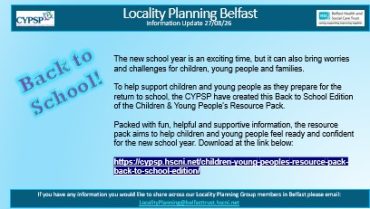
Belfast Locality Planning Newsletter – 4 June 2026

Banner titled “Locality Planning Belfast – Information Update 04/06/26” featuring two panels about the “This is our health” programme. The left panel provides a programme summary explaining the need for a new approach to health in Northern Ireland, focusing on prevention, community support, and shared responsibility between people and services. The right panel highlights a “new relationship between people and the health and care system,” includes a QR code linking to an online consultation, and web addresses for more information. Logos for CYPSP and Belfast Health and Social Care Trust appear at the top, with a contact email for the Belfast Locality Planning Group at the bottom.

Banner titled “Locality Planning Belfast – Information Update 04/06/26” featuring two panels about the “This is our health” programme. The left panel provides a programme summary explaining the need for a new approach to health in Northern Ireland, focusing on prevention, community support, and shared responsibility between people and services. The right panel highlights a “new relationship between people and the health and care system,” includes a QR code linking to an online consultation, and web addresses for more information. Logos for CYPSP and Belfast Health and Social Care Trust appear at the top, with a contact email for the Belfast Locality Planning Group at the bottom.

Download Issue

(Note: Newsletter will download directly to your device.  Look out for the pop-up box and click on open file when it appears)

If you have any information you would like to share across our Locality Planning Group members in Belfast, please email: LocalityPlanning@belfasttrust.hscni.net
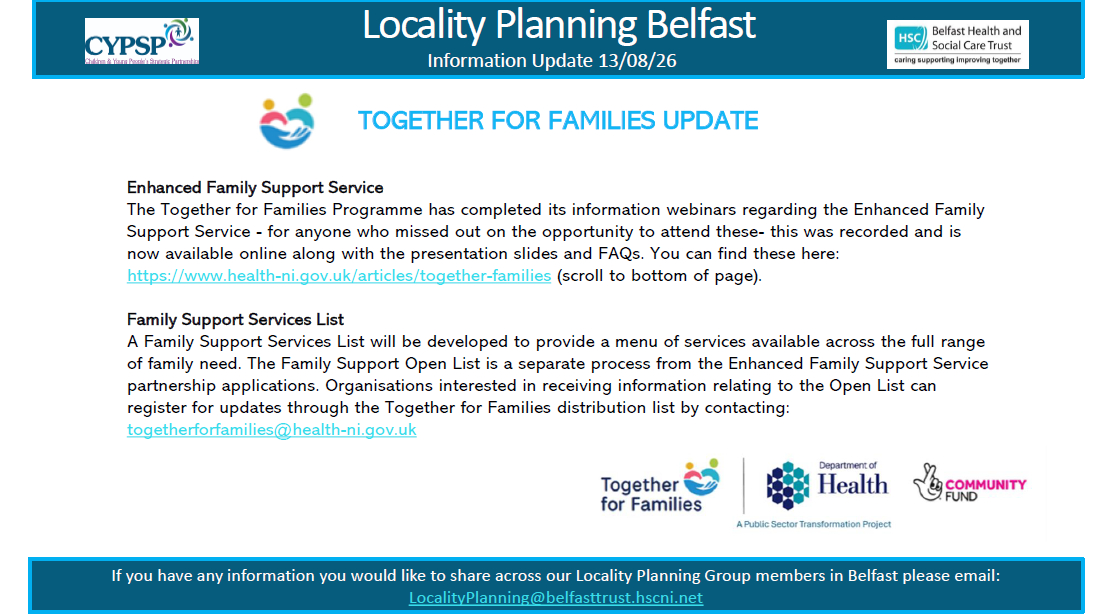
Belfast Locality Planning Newsletter – 21 May 2026

Graphic titled “Locality Planning Belfast – Information Update 21/05/26” with CYPSP and Belfast Health and Social Care Trust logos. The left side shows a report cover reading “How are Children & Young People doing in NI? Northern Ireland Outcome Monitoring Report with Trends 2017–24/25” and “Improving Outcomes,” alongside a photo of hands holding a page with charts and graphs. The right side highlights key findings from the report, including fewer children but growing need, health improvements alongside emerging concerns, rising disability and mental health pressures, strong educational attainment with attendance challenges, increasing numbers of looked-after children, and ongoing poverty and inequality. A footer invites contact via email for sharing information with the Belfast Locality Planning Group.

Download Issue

(Note: Newsletter will download directly to your device.  Look out for the pop-up box and click on open file when it appears)

If you have any information you would like to share across our Locality Planning Group members in Belfast, please email: LocalityPlanning@belfasttrust.hscni.net
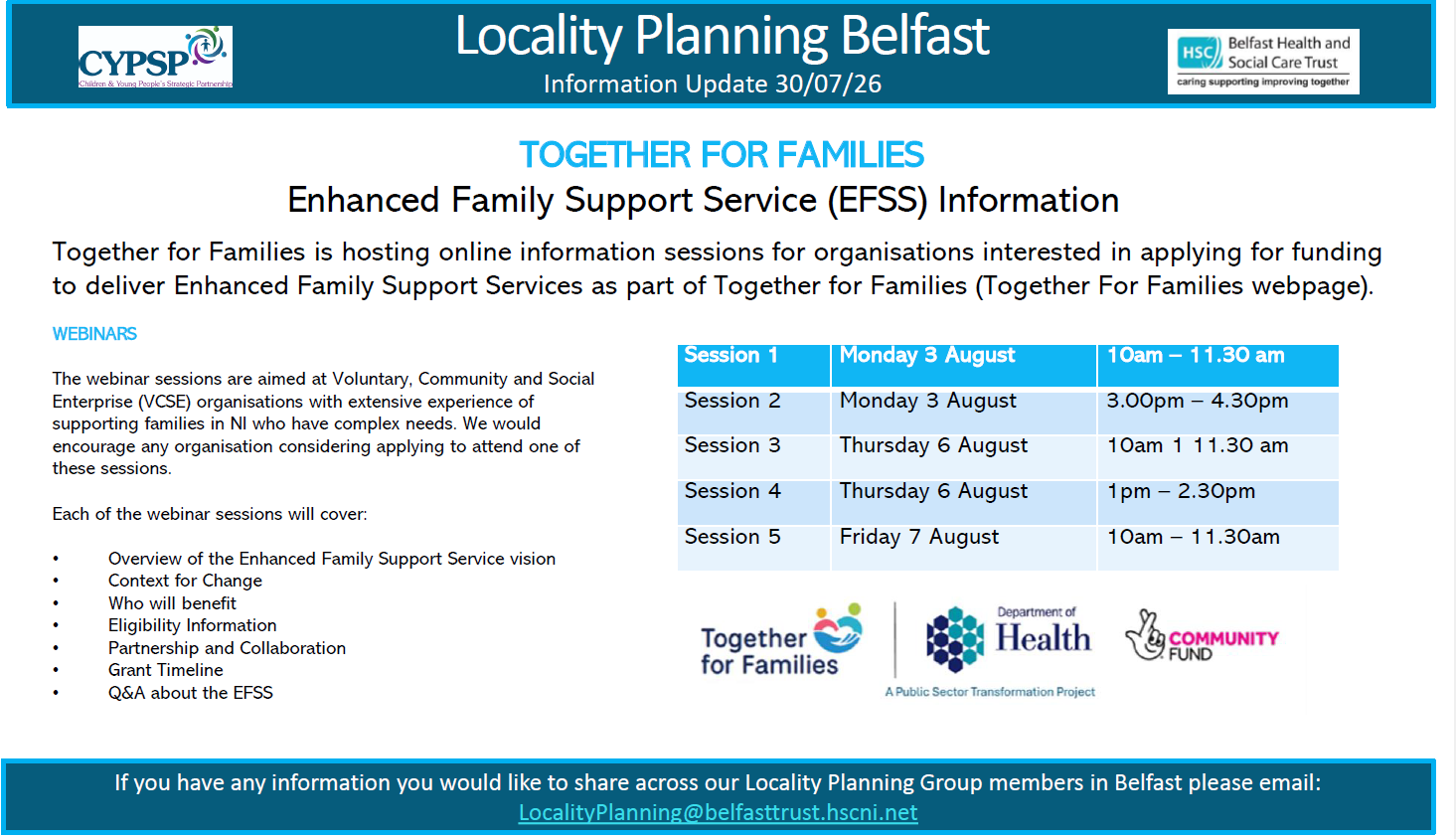
 

Belfast Locality Planning Newsletter – 7th May 2026

A digital poster with a coral background titled “Locality Planning Belfast – Information Update 23/04/26,” featuring logos for CYPSP (Children & Young People’s Strategic Partnership) on the left and Belfast Health and Social Care Trust on the right.The main heading reads “May is Women’s Health Month,” with supporting text explaining that eating well is important for women at all life stages and promoting free YouTube videos on topics such as forming healthy habits, planning for pregnancy, breastfeeding, and managing menopause.
In the centre, an illustration of an open laptop displays a YouTube channel called “Public Health Dietitians,” showing video thumbnails including “Planning your pregnancy,” “Eating Well during Pregnancy,” “Eating Well for Breastfeeding,” and “Making Menopause Manageable.”
To the right of the laptop, a yellow hand holds a smartphone displaying a QR code with text inviting viewers to find out more about nutrition and women’s health and watch on YouTube.
An “Eating Well” heart-shaped graphic appears near the top right.
A footer banner invites Locality Planning Group members in Belfast to share information via email, displaying the address “LocalityPlanning@belfasttrust.hscni.net.”

A digital poster with a coral background titled “Locality Planning Belfast – Information Update 23/04/26,” featuring logos for CYPSP (Children & Young People’s Strategic Partnership) on the left and Belfast Health and Social Care Trust on the right. The main heading reads “May is Women’s Health Month,” with supporting text explaining that eating well is important for women at all life stages and promoting free YouTube videos on topics such as forming healthy habits, planning for pregnancy, breastfeeding, and managing menopause. In the centre, an illustration of an open laptop displays a YouTube channel called “Public Health Dietitians,” showing video thumbnails including “Planning your pregnancy,” “Eating Well during Pregnancy,” “Eating Well for Breastfeeding,” and “Making Menopause Manageable.” To the right of the laptop, a yellow hand holds a smartphone displaying a QR code with text inviting viewers to find out more about nutrition and women’s health and watch on YouTube. An “Eating Well” heart-shaped graphic appears near the top right. A footer banner invites Locality Planning Group members in Belfast to share information via email, displaying the address “LocalityPlanning@belfasttrust.hscni.net.”

Download Issue

(Note: Newsletter will download directly to your device.  Look out for the pop-up box and click on open file when it appears)

If you have any information you would like to share across our Locality Planning Group members in Belfast, please email: LocalityPlanning@belfasttrust.hscni.net
New Report Highlights Changing Picture for Children and Young People in Northern Ireland

A newly published regional monitoring report reveals significant demographic change, growing pressures on services, and mixed progress across health, wellbeing and education for children and young people in Northern Ireland.

The Northern Ireland Outcome Monitoring Report 2017–2025, released today by the Children’s Services Planning Team on behalf of the Children and Young People’s Strategic Partnership (CYPSP), presents the most comprehensive picture to date of how children and young people are faring across eight key outcomes, drawing together multi‑agency data from health, education, justice and social care.  Download Here

Fewer Children, But Growing Need

The report shows that while children and young people still make up almost a quarter of the population, their numbers are falling. In 2024, Northern Ireland had 435,536 children aged under 18, representing 22.6% of the population. Population projections point to a 9.6% decline in the 0–17 age group by 2043, with the steepest fall among children aged 5–9.

At the same time, the needs of children are becoming more complex. The number of children in contact with services continues to rise, despite the shrinking child population, creating increased pressure on health, social care and education systems.

Health Gains Offset by Emerging Concerns

Encouraging progress has been made in some areas of child health. Births to teenage mothers have fallen to their lowest level on record, accounting for 2.0% of all births in 2024, and overall rates of smoking during pregnancy continue to decline.

However, the report highlights serious concerns:

  • Infant mortality increased to 4.5 deaths per 1,000 live births in 2024
  • MMR immunisation uptake fell to 89.7%, well below the WHO target of 95%
  • Breastfeeding at hospital discharge dropped to 46.2%, the lowest in eight years

Childhood obesity remains persistently high, with 15.5% of Primary 1 children overweight and 20.8% of Year 8 pupils classed as overweight in the most recent data.

Rising Disability and Mental Health Pressures

One of the most striking trends in the report is the continued rise in disability among children. By February 2025, over 34,600 children aged 0–15 were receiving Disability Living Allowance, with autism and ADHD featuring prominently.

Mental health indicators present a mixed picture. While 60% of 16‑year‑olds report good or excellent mental wellbeing, more than one in ten describe their mental health as poor. Hospital admissions for self‑harm among under‑18s fell overall, but remain higher than average in Belfast, Southern and Western Trust areas.

Education: Strong Attainment, But Attendance Challenges

Educational outcomes remain comparatively strong, with 87.4% of young people achieving five GCSEs at grades A–C*, though attainment in English and Maths continues to lag behind overall GCSE performance.

Attendance remains a concern:

  • 8.0% of primary pupils and 17.6% of post‑primary pupils attended school less than 85% of the time in 2024/25
  • Belfast consistently records the highest levels of absence

The proportion of young people aged 16–24 not in education, employment or training (NEET) stood at 9.4%, lower than the UK average, but still representing a significant cohort at risk of long‑term disadvantage.

Safeguarding, Care and Stability

At March 2025:

  • 2,283 children were on the Child Protection Register
  • 4,188 children were looked after, the highest number since records began under current legislation

Nearly half of children in care have been looked after for more than three years, highlighting the long‑term nature of intervention for many families.

The report also shows continued concern around domestic abuse, racist hate crime, and child homelessness, with more than 5,000 children living in temporary accommodation across Northern Ireland.

Poverty and Inequality Persist

Although child poverty levels have fallen slightly, around 67,000 children (15%) are still living in relative or absolute low‑income poverty. Western areas continue to experience higher rates, underlining long‑standing regional inequalities.

Free school meal entitlement remains high, particularly in Belfast and Western areas, reinforcing the link between deprivation and educational outcomes.

Informing the Next Children’s Services Plan

The report will directly inform the development of the Northern Ireland Children’s Services Plan 2025–2028, helping partners target resources, shape early intervention, and focus on outcomes where need is greatest.

Publishing today, CYPSP say the findings underline the importance of joined‑up planning, rights‑based approaches, and early support to improve outcomes for children, young people and families across Northern Ireland.