Changing Energy Related Behaviour Course

Training for frontline Staff – Thursday 7th March, 9:30am – 12:00pm

Habits and behaviours can be hard to change, but they can have a huge impact on how much a household spends on energy. The course will look at of some of the theories and findings in the field of decision making, focusing specifically on simple practical things they can do to encourage people to act on the energy-related advice they receive.

This course is designed for frontline staff working in a range of organisations who are in a position to provide energy-related advice directly to householders either face-to-face or via the telephone.

Download Flyer Here

All webinars are 2.5 hours and CPD accredited Webinars will be delivered live via Zoom (video conferencing facility) by our expert tutors to small groups to ensure a good level of interaction and support for learners. Participants will require a device with a camera and sound.

Hillsborough Castle and Gardens free subsidised school trip

Hillsborough Castle and Gardens,  has asked that we make you aware that they are launching a programme for all schoolchildren across Northern Ireland to visit Hillsborough Castle and Gardens for free on a completely subsidised school trip. Given education budgets are under pressure, they wanted to support schools to deliver out of the classroom learning experiences at no cost to them.

In the next few years, their ambition is to ensure that as many as 8,000 pupils per year have access to valuable education resources. We know that the cost of travelling on a school trip can also be prohibitive, so they’ve launched a complimentary Travel Bursary Scheme, that will also help support schools with travel costs.

Hillsborough Castle run facilitated sessions for all Primary, Secondary and SEN schools across the island of Ireland and GB. Their sessions support the local curriculum and explore Hillsborough Castle’s role as a family home, as well as in the political realm, from the 18th to the 21st centuries.

They cover Key Stage 2 with ‘Power and Politics’, Key Stage 3 with ‘The Origins of Northern Ireland’, Key Stage 4 and 5 with ‘Politics, Power and the Path to Peace’, plus Special Educational Needs and Disabilities (SEND) sessions on ‘A Working Home’.  There are also sessions on exploring life as a servant in an Anglo-Irish ‘big house’ getting ready for a Victorian wedding! We know how beneficial spending time outdoors is to the health and wellbeing of young people, and that’s why they are also delighted to be offering more schools free access to our gardens for programmes that explore nature, sustainability, and biodiversity.

They are committed to broadening access to Hillsborough Castle and to making sure it becomes a shared space for everyone. That’s why when they re-open the castle in March, they will also be offering £1 tickets for everyone in receipt of Universal Credit.

For more information contact Victoria Shaw Email: Victoria.Shaw@hrp.org.uk

Operations & Business Support Officer (Mon-Thurs), Historic Royal Palaces | Hillsborough Castle and Gardens, The Square | Royal Hillsborough | Co. Down | BT26 6AG

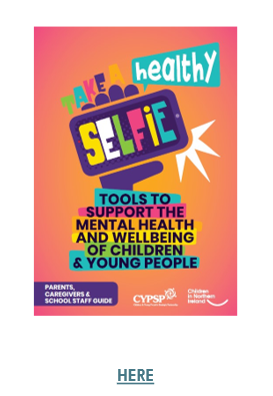
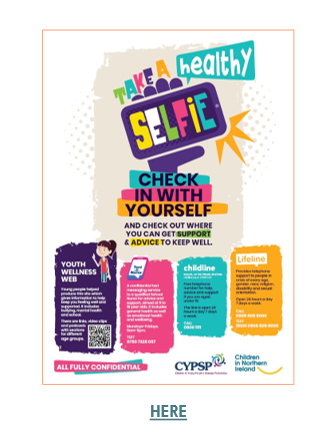
Take a Healthy Selfie – Check in on Yourself

Wednesday 7th February saw the online Launch of a new resource to support young people’s emotional wellbeing and mental health in the Southern Health & Social Care Trust Area. The “Take A Healthy Selfie” campaign includes 3 resources to signpost young people, parents/caregivers, school and youth work staff to support services in the Southern area. This resource was launched to coincide with Children’s Mental Health Week.

Originating from Banbridge Locality Planning Group (LPG) the aim was to work with young people to produce simple signposts to key quality-assured services and resources online. Young people from Futureproof, Crisis Café, New Bridge Integrated College and the Epicentre in the Southern area, advised on the themes, content and design for the resources.

The resources are available in electronic form (see links below) and paper copies. To order copies of this free resource, or to learn more of this campaign, contact Darren Curtis, Locality development Officer (Southern Area), at localityplanning@ci-ni.org.uk


Young Carers School Poster Launch

ALL SCHOOLS IN NORTHERN IRELAND URGED TO HELP IDENTIFY AND
SUPPORT YOUNG CARERS


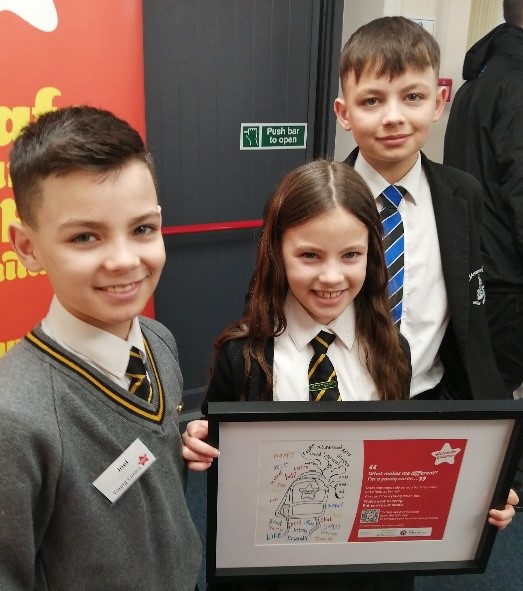
Pictured (L-R) Young carers Joel, Kesiah and Aaron with their poster (right)

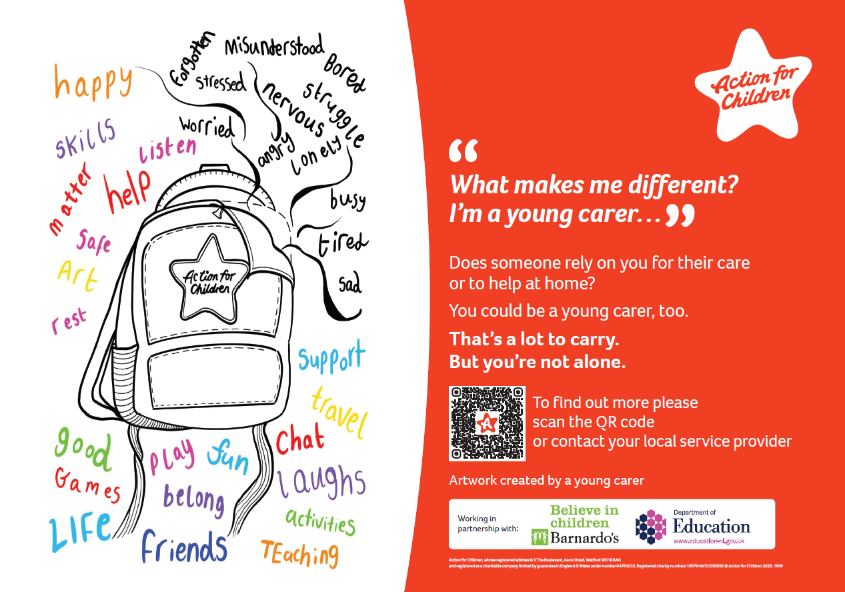
The Department of Education has partnered with Action for Children Northern Ireland to distribute a poster designed by Young Carers to all primary and secondary schools in Northern Ireland.

Download Poster Here

The Initiative comes in response to a campaign started by a group of Young Carers who wanted to create more awareness within schools of what being in a caring role is like and the impact it can have on their educational and social experiences.

The poster was designed by three siblings – Aaron (13), Joel (10) and Kesiah (9) – who are young carers for their older brother Christian (14). It was launched at an event on Monday (January 29) at Action for Children’s Head Office, Loughshore House, alongside colleagues from Barnardo’s NI.

A young carer is someone 18 years old or under who helps look after a relative with a disability, illness, mental health condition, or drug or alcohol problem. Some children begin giving care from a very young age, and others become carers overnight. There are also many young adult carers that try to juggle a caring role with their own education and early employment journeys, that also often need some extra support.

There are currently over 17,500 unpaid carers aged under 25 in Northern Ireland that we know of, however there are likely to be more because they are often hard to identify. This figure makes up roughly 8% of Northern Ireland’s carer population and includes more than 2,500 carers aged under 15, and 550 carers under the age of 10 years old1.

Surveying young carers across the Belfast, South and South-Eastern Trust, Action for Children found that less than one in six (16%) of young people who take on a caring role feel that their schools support them2. Many of them feel that most teachers don’t know what a young carer does each day or how it impacts their ability to learn.

For most children, getting into school is a case of rolling out of bed and hoping to grab a slice of toast on the way out the door, but for a young carer their day often starts hours before the school bell rings.

But a young carer takes on an average of 25 hours of unpaid work per week to support their family through various duties and tasks that keep a household running. They often forgo extra-curricular activities, struggle to find time to do homework and carry worries and concerns many other children may not need to manage.

Aisling Reynolds, Services Manager for Action for Children Young Carers, has taken the lead in ensuring schools better understand and support the role of young carers. Aisling said: “It’s evident that a school’s awareness and level of support for a young carer can make a huge difference to not only their experience in education, but their confidence, self-esteem and ability to progress further.

“By launching this school poster, our hope is that young carers can recognise their caring role and see that there is support in the community for them. Educators can also access and receive information on how to support young carers in their classrooms, enhancing the experience of young people with caring responsibilities in schools across Northern Ireland.”

Welcoming the launch, Dr Mark Browne, Permanent Secretary for the Department of Education, said: “The challenges of balancing school with the demands of providing physical care, personal care and emotional support to family members on a daily basis cannot be underestimated.

“I hope that by providing this Young Carers in Education Digital Awareness Pack to educational settings and highlighting this issue, we can help to facilitate a better understanding around the role of young carers, the challenges they face and support available.”

Chloe, a Young Carer previously supported by Action for Children while still at school attended Monday’s launch. She was part of the original group that started the campaign and said: “If this poster was in school when I was in school, it would’ve made a difference for me”.

Eileen Maguire, Manager of Barnardo’s NI Young Carers service said: “Young people with caring responsibilities have all the challenges of being young, with all the responsibilities of being an adult, and they’re often left to face these alone.”

“The young carers we work with at Barnardo’s NI are an incredible bunch of people and I am reminded daily of their resilience and compassion. By getting this information into schools, we hope it will help identify more young carers who need support.”

ENDS

CYPSP Pause and Reset Workshop

CYPSP PAUSE AND RESET WORKSHOP

Wednesday 4th October 2023:  Lagan Valley Island Lisburn

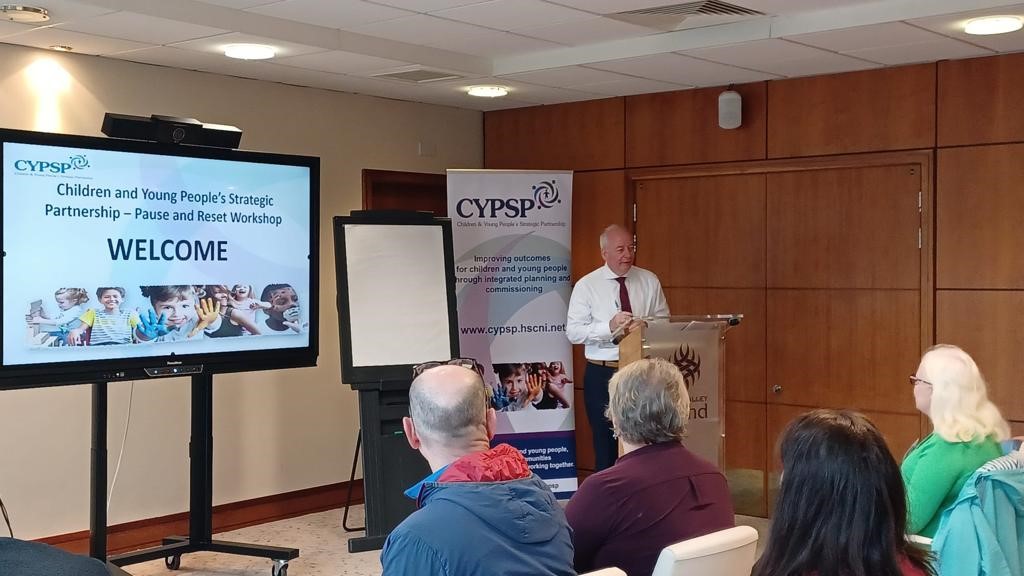
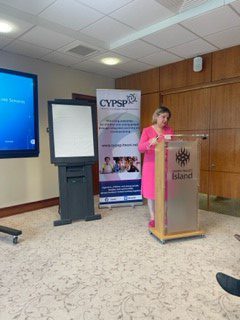
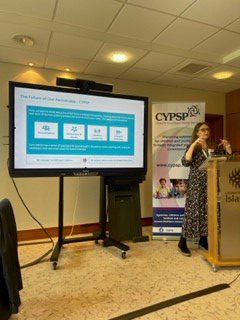
The Children and Young People’s Strategic Partnership (CYPSP) held a workshop on Wednesday 4th October 2023 at the Lagan Valley Island in Lisburn to give members, as well as invited delegates from Outcomes Groups and Locality Planning Groups, an opportunity to review the strategic direction of CYPSP and look at how the collective leadership could be strengthened moving forward towards the next 3year Northern Ireland Children’s Services Plan.

Aidan Dawson, Chair of CYPSP and Chief Executive of PHA, opened the workshop and gave a brief overview on context, history and achievements of CYPSP to date, and outlined some of the new challenges and opportunities facing the partnership that were being shared with members by 4 key speakers during the morning.

View Examples of CYPSP Achievements Video 21-23

The Independent Review of Children’s Social Care Services

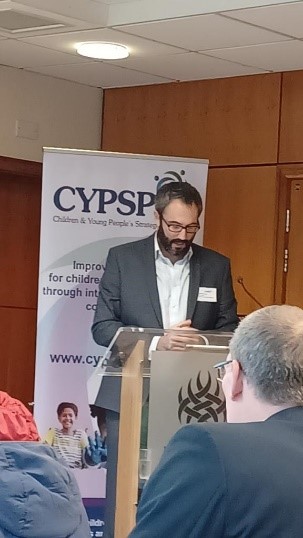
Eilis McDaniels, Director of Family & Childrens Policy at the Department of Health, shared the out workings of the review carried out by Professor Ray Jones outlining the 3 specific strands the review focused on and specific key reflections and recommendations that were identified within the review. She noted that although the review was silent in respect of CYPSP, the recommendations were in line with the ethos of CYPSP in respect of organisations working together to improve outcomes for children and families.

The review is currently out for public consultation and Eilis encouraged members to provide as much feedback as possible on their own views and that of their organisation.


Children and Young People in Community Planning

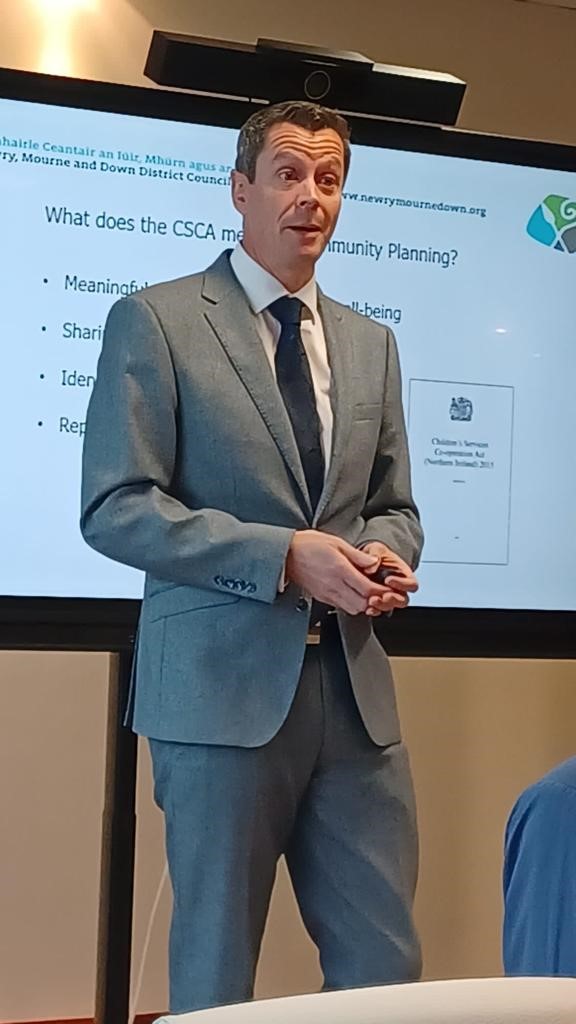
David Burns, Chief Executive of Lisburn City and Castlereagh Council and Chair of SOLACE stepped in at short notice on behalf of Marie Ward, Chief Executive of Newry, Mourne and Down Council, to provide an overview of community planning, the focus on children and young people within community planning and shared collaboration and activity that was currently happening between local councils and CYPSP.

David referred to the importance of the Children Services Co-operation Act and the opportunities of working as equal partners through meaningful co-operation to improve wellbeing, share resources and pooling funds to deliver better outcomes for children and families across each council area.  He shared the numerous connections already in place with CYPSP across all council areas and acknowledged the importance of continuing to strengthen those links and partnership working to enhance delivery against shared priorities.

Northern Ireland Integrated Care System

Vincent Ramirez and Allan Chapman from ICS Programme Directorate, gave a background to ICS being the new commissioning framework for Health and Social Care services in Northern Ireland based on collaboration and integration as a single planning system for NI focusing on improving outcomes and reducing health inequalities. He shared the Strategic Outcomes Framework that includes an outcome that Children and Young People will have the best start in life.

Vincent highlighted the clear importance of ICS linking to existing partnerships and networks in working with wider partners both regionally and locally with ICS providing strategic leadership for system alignment that will help inform Departmental decision making on priorities.  Vincent and Allan also shared information on the Southern Test AIPB and the importance that they link locally in respect of ongoing work to avoid duplication of effort and ensure information on needs and gaps are shared back into the AIPB and to look at where ICS/AIPB could add value back to local partnerships.


Mental Health Strategy: Early Intervention and Prevention

Stephen Murray, Public Health Agency, informed members that as the regional lead organisation for commissioning early intervention and prevention services to promote positive mental health and wellbeing, the PHA is taking the lead role for delivery of Actions 1 & 2 of the Mental Health Strategy.  He outlined progress on the implementation structure to date in respect of steering groups and subgroups and workshops in respect of taking forward Actions.

Key areas highlighted included communication and public awareness raising, develop or expand existing systems for sharing information on services, creating supportive environments and training and capacity building to support early intervention and prevention. Stephen also acknowledged the importance moving forward on continuing to build the network and relationships and making links with CYPSP and others to avoid duplication and to look at good practice in delivering on Actions 1 and 2.

Afternoon Sessions

The afternoon sessions focused on the future of CYPSP by looking at what is working well currently; what could be better; and what could the future look like and in particular taking on board the morning presentations.

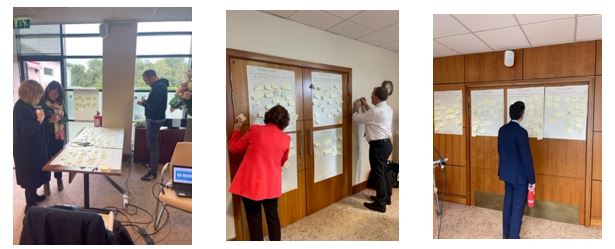
Ella and Lynsey from the Leadership Centre facilitated the afternoon sessions.   The first session explored CYPSP from a Strategic Perspective with 4 stations set up around the room looking at accountability; partnership and equity; collective leadership; and impact and outcomes.

Members were provided with sticky post its and pens to share their thoughts based on a series of questions at each station focusing on what is working well, where do challenges exist and what would the future look like.

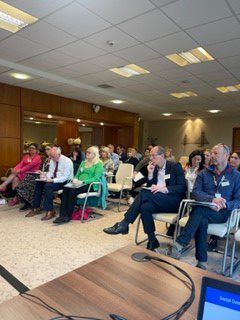
The buzz in the room was great with all members participating in the exercise with loads of thoughts and information shared.

The second session in the afternoon included members breaking into 3 groups to specifically look at outcomes groups, locality planning groups and regional sub-groups.  Each group was facilitated again to look at what is currently working, what are the challenges and what could be done better.


Again, there was enthusiastic discussions and great feedback captured and we will share the final outcome report across CYPSP.

5 Oct 23