FSH Newsletter – August Edition

The August edition of the Family Support Hub Newsletter is now available at:  https://cypsp.hscni.net/download/391/family-support-hubs/46617/fsh-newsletter-aug2025.pdf

(Please Note: Newsletter will download directly to your device.  Look out for the pop-up box and click on open file when it appears).

As summer begins to wind down and the back-to-school buzz starts to build, we’re here to help you make the most of the season and prepare for the months ahead. Whether you’re a parent, carer, or professional working with families, this edition is packed with useful updates, local services, and seasonal activities to support you and those you work with.

We have been busy gathering a fantastic mix of information—from fun end-of-summer events to practical resources for the new school term. We know this time of year can be a mix of excitement and stress, so we hope this newsletter brings a bit of ease, inspiration, and connection.

It is also packed full of information for parents/carers, early years, children & young people with a disability,  mental health and wellbeing advice,  Helplines and much more – make sure you download your copy now!

Previous editions of the newsletter are available at  http://www.cypsp.hscni.net/family-support-hubs  under Family Support Newsletter section.
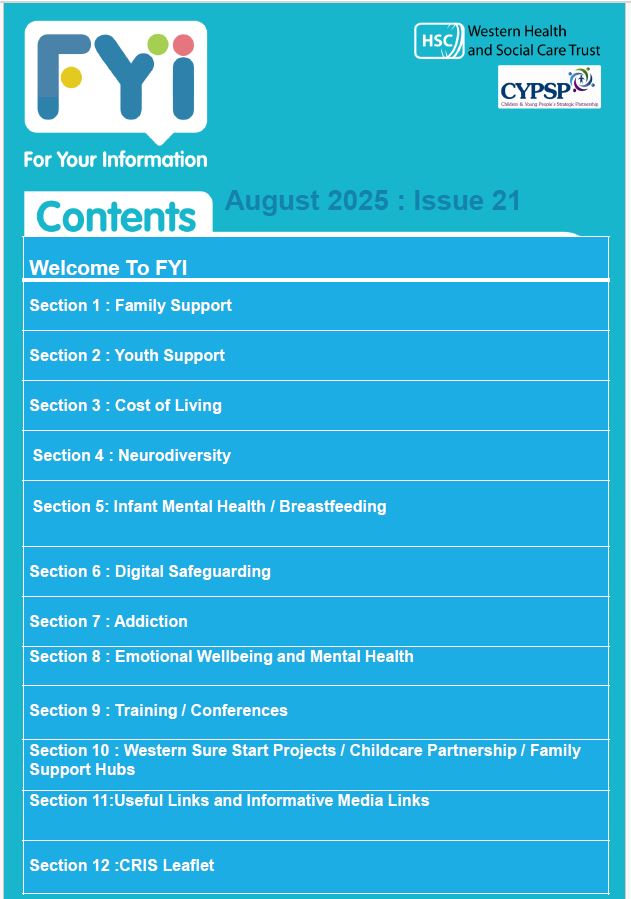
Western Area FYI – Issue 21 – August 2025

Your FYI is a monthly round up of all things family support and early intervention / prevention across the Western trust and beyond.

Image with text promoting Western Area FYI (For Your Information)

Download Issue 21

(Note: Newsletter will download directly to your device.  Look out for the pop-up box and click on open file when it appears)

If you would like to contribute upcoming consultations, training, articles, or events that practitioners from the community, voluntary or statutory sectors within the Western Trust will find useful please contact:

Dr Priscilla Magee – Mobile  07880723076     priscilla.magee@westerntrust.hscni.net

Paul Sweeney – Mobile  07387259117     paul.sweeney@westerntrust.hscni.net


Mental Health Strategy – Early Intervention and Prevention – Service Directory

In support of actions 1 and 2 of the Mental Health Strategy and Mental Health early intervention and prevention, the Public Health Agency are encouraging all stakeholders to contribute to the new Minding Your Head webpage service directory.

You are invited to add mental health and emotional wellbeing services (outlined in the ‘service type’ section of the guide) your organisation provides in your local community.

Please also engage with all organisations that you commission to encourage them to add their services, and share this opportunity for inclusion in the service directory with your partnerships and networks.

Please make separate submissions for each service. The purpose of submitting individual services offered by your organisation is to benefit the individual searching the directory to understand the specific support options available to them.

Adding your service

Please follow the instructions below and the attached guide to add each service to the directory.

The attached guide outlines the following:

  1. Eligibility criteria
  2. Exclusion criteria
  3. Service type
  4. Public Health Agency quality standards  
  5. Information accuracy and completeness
  6. Information required
  7. Content guidelines
  8. Verification and updates
  9. Consent

Setting up your Minding Your Head account

  • Your username is the email address used to receive this correspondence.
  • Using this email address please follow this link [Reset your password | Minding Your Head] to generate a temporary password. You will then be able to set a new password and update your organisation’s contact details and add information for all your organisations services.
  • Remember to make separate submissions for each service.

Adding service submission details

  • Refer to the attached guide for details.
  • If you wish to add email information to your submission form please do not use personalised email addresses such as ‘joe.bloggs@’, instead use generic email addresses such as ‘info@’.

If you would like to remove your service from the Minding Your Head website and contact list, please respond ‘opt out’ to this email.  

Email any queries to myh@hscni.net  

Mental Health Data and Outcomes Conference – QUB

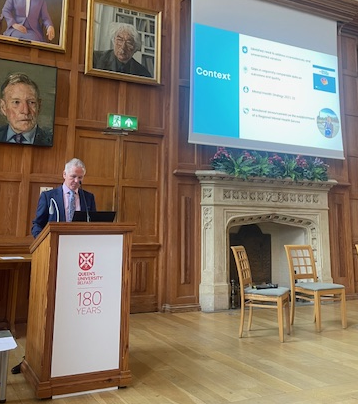
Children’s Services Planning team members Valerie Maxwell, Children Services Planning & Information Manager and Bronwyn Campbell, Lead for the Family Support Hubs Network were delighted to attend and present at Queen’s University Belfast Mental Health Data and Outcomes Conference on Tuesday 20th May 2025 in the Great Hall, along with Strategic Planning and Performance Group colleagues, Gavin Quinn, Head of the Regional Mental Health Service and Martina McCafferty, Mental Health Lead.


Gavin opened the conference and provided  context and an overview of the development of the new Regional Mental Health Service and the importance of Data to the Service moving forward.  Martina along with colleagues Hannah Brown, BHSCT and Mary Donaghy, Macmillan provided an update on the Journey of Think Family in NI and the benefits of implementing the model across systems.  they also shared how they were developing data and outcomes across complex systems.


Valerie and Bronwyn presented on reporting trends and capturing outcomes over time – Valerie shared information about the Children and Young People’s Strategic Partnership and how they have implemented an OBA Outcomes planning framework across their infrastructure based on a multi-agency outcomes and indicator framework.  She also shared examples from the CYPSP Information systems including their Interactive Map Dashboards and new NI Outcome monitoring report presenting information at different geographical levels from Northern Ireland level, to Local government District, Trust level data and down to Ward level highlight how the data is used to assess need and also measure population outcomes.

Bronwyn then presented how information is used at Family Support Hub level providing an overview of what Family Support Hubs are and their purpose. She focused down to the 8 Hubs in the WHSCT area and provided information on supporting children, parents and families with their emotional wellbeing and mental health.  Bronwyn was also able to share how unmet need is identified on the ground and fed back up through locality planning groups and outcomes groups for partners to look at how best as a multi-agency partnership they can fill those gaps and meet the needs.  Bronwyn then shared an anonymised case study on one child and mother’s journey and the positive impact and outcomes achieved following support identified by the local hub.

Valerie concluded the presentation by sharing examples of CYPSP Report Cards and Family Support Hub Report Cards.

Mental Health Champion visit to Ebrington – May 2025

Pictured at the roundtable event are (from left), Lorna Ballard, Louise Kearney, Siobhan O’Neill, Donna Downey and Bronwyn Campbell.

Pictured at the roundtable event are (from left), Lorna Ballard, Louise Kearney, Siobhan O’Neill, Donna Downey and Bronwyn Campbell.


Mental Health Champion for Northern Ireland, Professor Siobhan O’Neill, recently visited Ebrington, Derry~Londonderry, to hear first-hand how Family Support Hubs are supporting local people.

 Organised by the Western Health and Social Care Trust and chaired by Action for Children, a roundtable discussion on Thursday 8 May was designed to showcase the work of the eight Family Support Hubs from across the Western Trust.

Donna Downey (Western Trust) and Bronwyn Campbell (Strategic Planning and Performance Group, Department of Health) introduced the background and context of Family Support Hubs. Essentially, a Family Support Hub is multi-agency network of statutory, community and voluntary organisations that provide or signpost to early intervention services. Hubs are a part of the Children and Young People’s Strategic Partnership (CYPSP).

Each of the Hubs gave a short presentation on their area, including the challenges they face and as examples of success stories they are proud of.

Attendees then had an opportunity to hear from Ms O’Neill herself. She said she was ‘really struck’ by the ‘passion and commitment’ of the Hubs’ staff and was moved by the case studies they shared with her.

She echoed the presenters’ concerns about the rates of poverty in Northern Ireland and how that underpins so many aspects of people’s lives, including their mental health.

Ms O’Neill also answered a number of questions, including how to make government understand the needs of people on the ground.

She said: “There’s this misguided idea that if we could just get more people back to work then there would be more money in the economy and everything would be fine – that’s just wrong.

“What we really need first and foremost is a healthy population that are fit and well. The cost of poor mental health is £3.4 billion annually here. We’re fighting a battle against short-termism – early intervention, parenting support, Sure Starts and so on is where money needs to be going.”

 Other questions included Ms O’Neill’s position on linking and utilising key pieces of legislation, including a Mental Health Strategy and an Anti-Poverty Strategy for Northern Ireland. She agreed that policies and strategies need to be aligned and actually implemented, and she said she would be seeking a meeting with the Department of Health to raise a number of the issues that were highlighted at the event.

Speaking after the event, Donna Downey (WHSCT) said: “It was a pleasure to meet with Siobhan O’Neill and share the innovative work the Family Hubs. It is an opportunity to acknowledge the professionalism and commitment of all of the staff who work collaboratively with families every day.”

Louise Kearney (Action for Children) added: “In the North-West the statutory and community and voluntary sectors work ‘hand in glove’ to make sure that vulnerable children, young people and families are supported and given the chance to thrive.

 “Mental health underpins so much of the work we do so we’re delighted that Ms O’Neill has been able to hear about the challenges we face, and also learn about the stellar work that’s happening. Family Support Hub model has potential for further growth and development to support more people in local communities.”